


tech
Bio-Age: How Old Is Your Body, Really?
Bio-Age on iPhone turns your steps, VO2max and health data into one number: how old your body really is, plus clear tips to make it younger.
By Andreas Dolinsek, CTO at StepsApp
Your birth certificate tells you how old you are. It doesn’t tell you how old your body is.
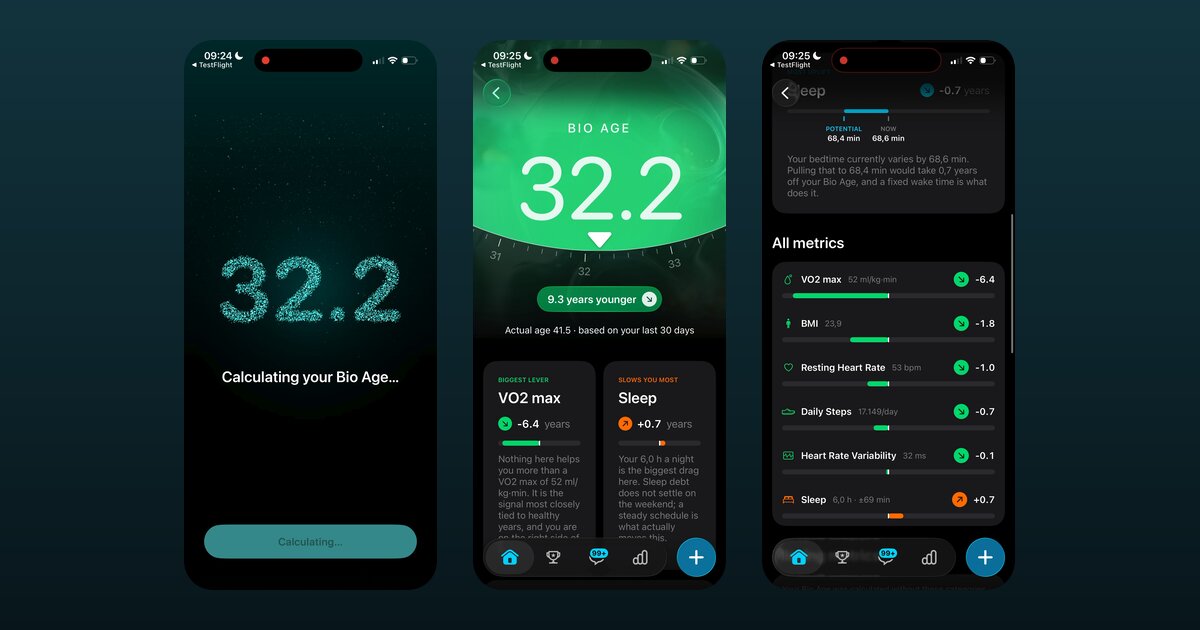
That’s the idea behind Bio-Age, our newest feature. It takes the health data your phone and watch already collect and turns it into one number: how old your body actually is. Then it tells you what to work on.
Bio-Age is available on iPhone for now and uses your Apple Health data. Android will follow.
Why we built it
StepsApp has always been about steps. But your phone knows a lot more about you than that. Resting heart rate, sleep, weight, VO2max. Most of it sits in a health app as a long list of numbers.
And what do you do with them? Is a resting heart rate of 64 good? Is 6 hours of sleep a problem? Which of these actually matters?
We didn’t want to add more charts. We wanted one number that answers those questions, and a clear next step.
How it came together
Very short version: a lot of reading and a lot of math.
There’s decades of research on how fitness, activity, sleep and body composition affect how long people live. Large studies, hundreds of thousands of participants. We took those findings and built a model that converts each of your health values into years. Some add years to your age, some take years off.
A few things were important to us:
- No black box. Bio-Age isn’t an AI guessing your age. It’s plain math based on published research, and you can see exactly which factor adds or removes how many years.
- Compared to people like you. You’re measured against an average person of your age and sex. A 60-year-old isn’t compared to a 25-year-old.
- No double counting. Many metrics are connected. Fit people usually have a lower resting heart rate too. The model makes sure the same habit doesn’t count twice.
Getting the numbers right took a lot of iterations. Making them understandable took just as many.
Why VO2max matters so much
If there’s one thing we learned while building this, it’s that VO2max is underrated.
VO2max measures how much oxygen your body can use during exercise. Basically: how fit your heart and lungs are. A 2018 study of over 120,000 people in JAMA Network Open found that cardiorespiratory fitness is one of the strongest predictors of how long people live. Being unfit carried a risk comparable to, or even greater than, smoking or diabetes. And there was no upper limit. Fitter was always better.
So VO2max has a big influence on your Bio-Age. With a good VO2max, it can take several years off.
The good part: you can train it. Brisk walks, walking uphill, some intervals. You don’t need to run marathons. The biggest gains come from going from unfit to a bit fit. If you wear an Apple Watch, it estimates your VO2max automatically when you walk or run outdoors, and Bio-Age picks it up from Apple Health.
What to work on next
A number alone doesn’t help much. So Bio-Age also shows you where you can gain the most years.
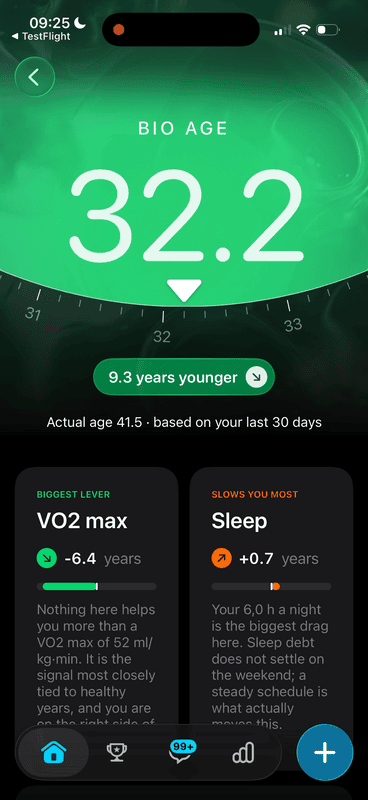
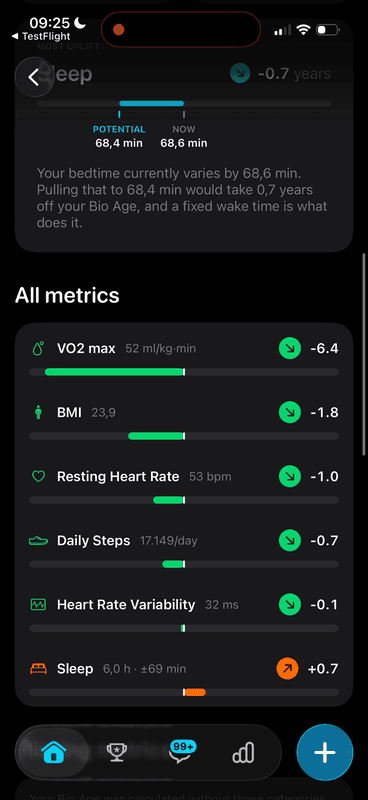
Every factor shows how much it adds to or takes off your age. On top of that, you get recommendations. Maybe your steps are fine, but your sleep costs you a year. Maybe your weight is fine, but your VO2max has room to grow. You know which one to start with.
In the example below, VO2max is the biggest plus, while short sleep and an irregular bedtime cost a little. Bio-Age shows that, and how much a fixed wake time would give back.
See it in action
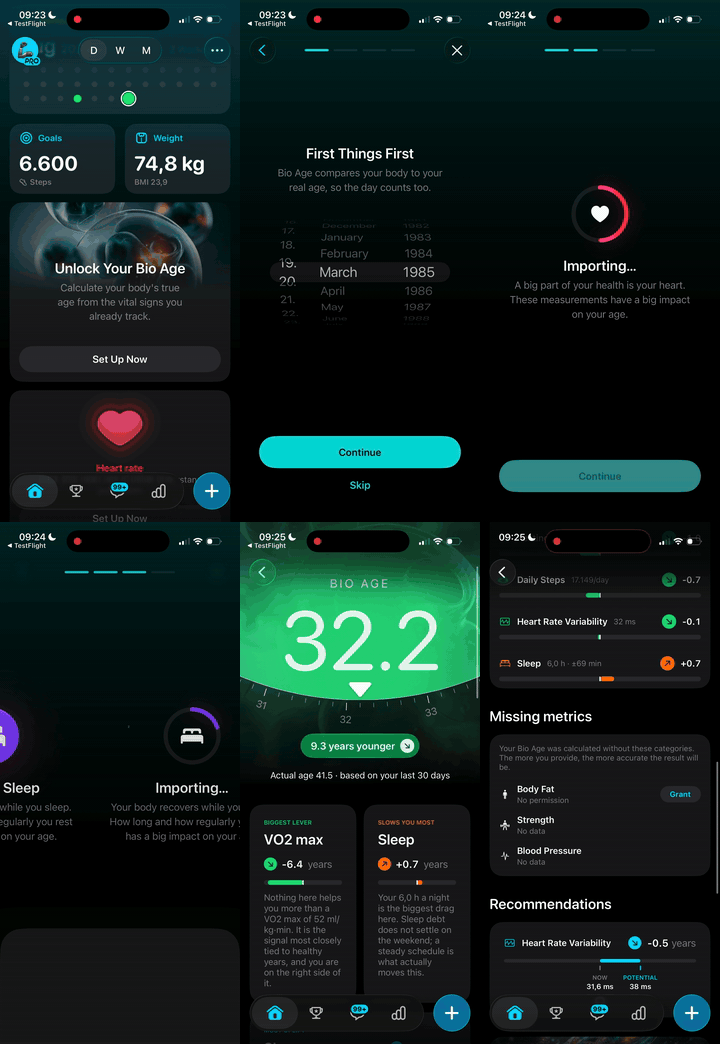
Setup takes less than a minute. Enter your birth year, allow access to Apple Health, done. You also see which metrics are still missing, like body fat, strength or blood pressure. The more you add, the more accurate it gets.
From step counter to health dashboard
With Bio-Age, StepsApp becomes more than a step counter.
Your steps are still the core. But now they sit next to your heart rate, sleep, fitness and body measurements, and all of it adds up to one number you can actually understand. A walk isn’t just a bar in a chart anymore. You can see what it does for you.
That’s where we want to go: a real health dashboard that shows how you’re doing and what to do next.
Bio-Age is a wellness tool, not a medical diagnosis. If something in your data worries you, talk to your doctor.
Try it
Check your Bio-Age in StepsApp →
And then go for a walk.
Have fun 🙂
Andi
Sources
- Mandsager K, Harb S, Cremer P, et al. Association of Cardiorespiratory Fitness With Long-term Mortality Among Adults Undergoing Exercise Treadmill Testing. JAMA Network Open, 2018. (PubMed)