


challenges
Team Challenge: The Feature You Kept Asking For
Team Challenge is here: the most requested challenge feature ever. Why entire countries asked for it, and how daily averages keep it fair.
By Andreas Dolinsek, CTO at StepsApp
Most features start as an idea inside the team. This one didn’t.
Team Challenge exists because you asked for it. Again and again. If we had to name the single most frequent piece of feedback we’ve ever received about challenges, this is it: “Can we compete as teams?”
So we built it. Here’s the story - and how it works under the hood.
The feedback that wouldn’t stop
Individual challenges are great when everyone’s on a similar level. But the moment groups got bigger, the same message kept landing in our inbox.
Companies wanted Marketing vs. Sales vs. Engineering. Schools wanted class against class. Families wanted cousins against cousins.
And then it got bigger. Entire countries reached out, wanting to let states, regions, and districts challenge each other. When a health initiative asks you how to get a whole nation walking against itself, you stop wondering whether the feature is worth building.
The message was loud and clear: people don’t just want to walk against each other. They want to walk with each other - against another team.
Why we score by daily average
The obvious way to score a team challenge is to add up everyone’s steps. It’s also the wrong way.
With total steps, the bigger team basically always wins. A team of 40 beats a team of 12 before anyone puts on their shoes. That’s not a challenge - that’s a headcount.
So Team Challenge uses the daily average steps of the team instead. Every day, we take the steps of your teammates and average them. Team size stops mattering. A department of 8 can absolutely take down a department of 80.
And there’s one small rule that makes a big difference: players with 0 steps are excluded from the calculation. 🙂
Why? Because zero-step days are almost never about laziness. Someone’s phone was off. Someone was sick. Someone joined the challenge and forgot to open the app. If we counted those zeros, one inactive teammate could drag down twenty active ones - and nothing kills team spirit faster than being punished for something outside your control.
Mathematically and gameplay-wise, we think this is the fairest approach. Your team’s score reflects the people who actually walked that day. No dead weight, no team-size tricks.
It’s not one challenge - it’s a mode
We didn’t build Team Challenge as yet another challenge type sitting at the end of a list. We built Team Mode into the challenge types you already know:
- Daily Steps: hit a daily goal, team against team. Which side shows up more consistently?
- Steps Goal: reach a step target before time runs out. Every team that makes it, wins.
- Most Steps: the classic. Whichever team averages more, wins.
- Group Goal: everyone contributes to one shared target. As teams, you get there together.
Same challenges, same rules you’re used to - just flip on Team Mode and pick your sides.
See it in action
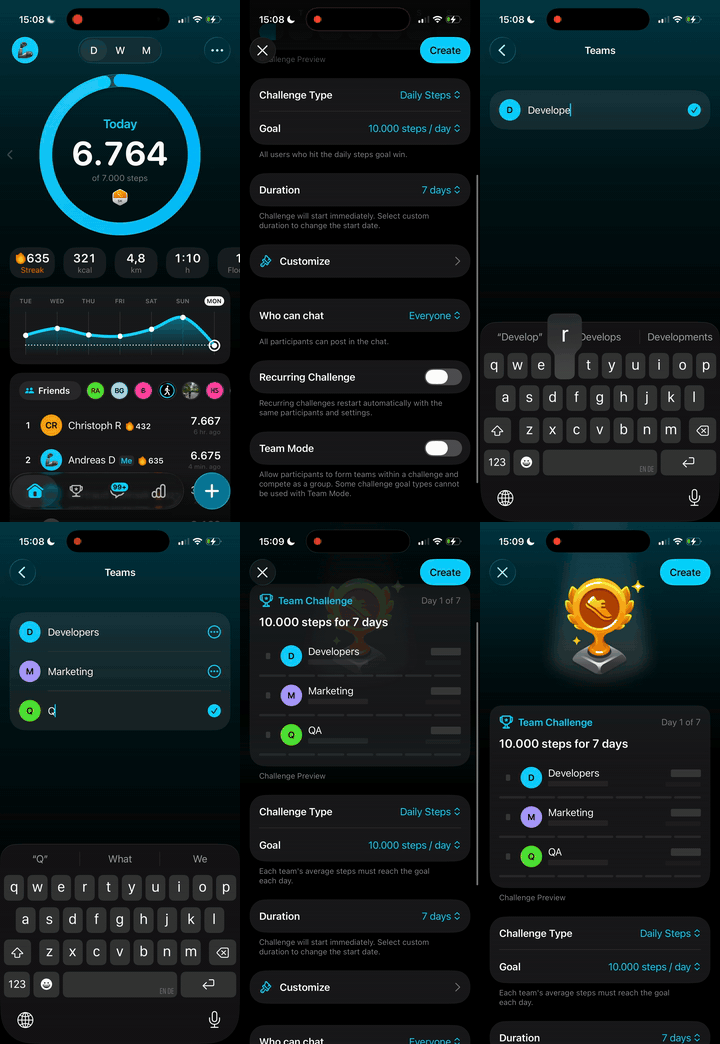
That’s the whole setup. Pick your challenge type, set a goal, add your teams - Developers, Marketing, QA, whoever’s brave enough - and you’re off. It takes about a minute, and most of that is arguing over team names.
No spectators: pick a side
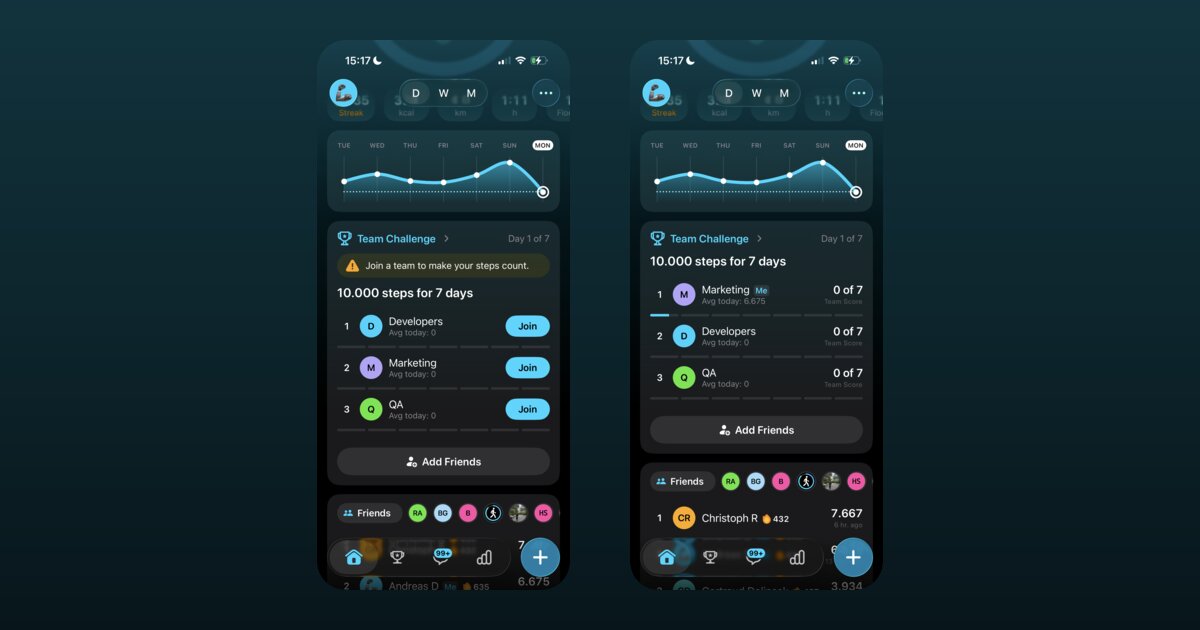
When you open a Team Challenge you haven’t joined yet, your steps don’t count for anyone. First, you pick your team - and until you do, a friendly banner reminds you: “Join a team to make your steps count.” You can see exactly that moment in the two screens at the top of this article.
One tap on Join and you’re in. From that moment, every step you take moves your team’s daily average.
What averages do to team spirit
Scoring by average changes how a team behaves - in the best way.
In a total-steps world, the strongest walkers carry everyone and the rest can hide. In an average-steps world, every active member moves the needle. Your 6,000 steps count exactly as much toward the average as the team captain’s 6,000.
We’ve watched this play out in early tests: teams start checking in on each other. “You walking today?” becomes a daily ritual. The competition stops being between individuals and starts being between groups that genuinely want every member to show up.
That’s the behaviour we were hoping for. Honestly, it worked even better than expected.
From office floors to entire countries
The beauty of team-vs-team is that it scales to whatever “team” means to you.
Two friend groups. Two office floors. Two branch locations. Two schools. And yes - two federal states, if that’s the size you’re playing at. The mechanic is the same whether there are 5 people per team or 5,000: daily average, active players only, may the most consistent team win.
And here’s the part that surprises people: it’s entirely free. No premium tier, no per-seat pricing, no “contact sales” button. A Team Challenge supports up to 100,000 participants out of the box. If you’re planning something even bigger than that, write us at [email protected] and we’ll make it happen for you. 🙂
Try it with your team
Start a Team Challenge in StepsApp →
Pick your teams. Pick your rivals. Then watch what happens when Sales realizes Engineering is averaging 9,000 a day.
Have fun 🙂
Andi