


challenges
Steps Battle Royale: How It Was Born
StepsApp CMO Ylli Qerkini on how Battle Royale was born, what daily elimination does to a group chat, and why avoiding the Red Zone is more motivating than chasing the top.

By Ylli Qerkini, CMO at StepsApp
I’ve been obsessed with step challenges for years. Not just building them — actually running them. Testing them on friends, on colleagues, on family members who didn’t fully understand what they were signing up for.
And the thing that always bothered me was the same: the middle days die.
Day one, everyone’s excited. Day two, there’s still energy. Day four? People are coasting. Someone’s already mentally checked out. The leaderboard freezes. The group chat goes quiet.
I kept thinking: what if you couldn’t coast? What if every single day meant something — because every single day, someone goes home?
That’s where Battle Royale started.
The idea: make every day count
The mechanic I had in mind was brutal in its simplicity. You start with a group. Each day, the players with the fewest steps fall into the Red Zone. Stay there too long and you’re eliminated. Last person standing wins.
No safe leads. No catching up tomorrow. Every morning, the clock resets and the pressure starts fresh.
I pitched it internally and got a mix of reactions. Some people loved it immediately. Others worried it was too punishing — that getting eliminated on day two would feel awful.
Both reactions turned out to be right, and that tension is exactly what makes it work.
Why “avoid the bottom” beats “reach the top”
Here’s the thing about traditional leaderboards: they only really motivate the top few players. If you’re in eighth place out of fifteen, you’re not thinking about the leader. You’ve mentally written off the win.
Battle Royale flips that completely.
When the goal is to avoid the Red Zone — not to win outright, but just to survive one more day — every single position on the leaderboard matters. The player in fifth place isn’t watching the leader. They’re watching the two people below them in the Red Zone, making absolutely sure they’re not joining them.
I’ve watched people in sixth place walk 11,000 steps on a day they would have normally walked 3,000 — just to avoid being seventh.
That’s the behaviour change we’re after.
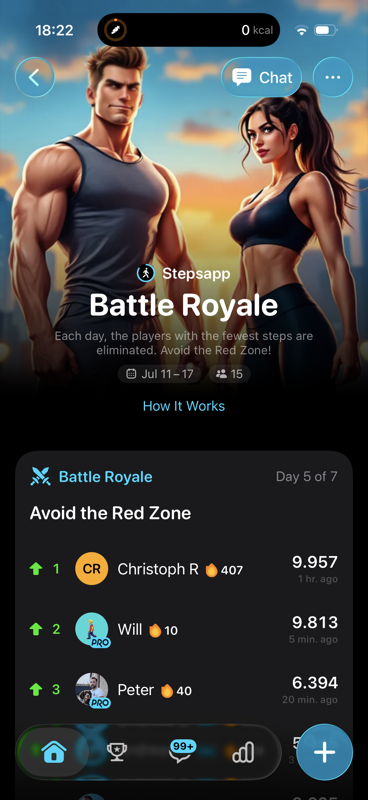
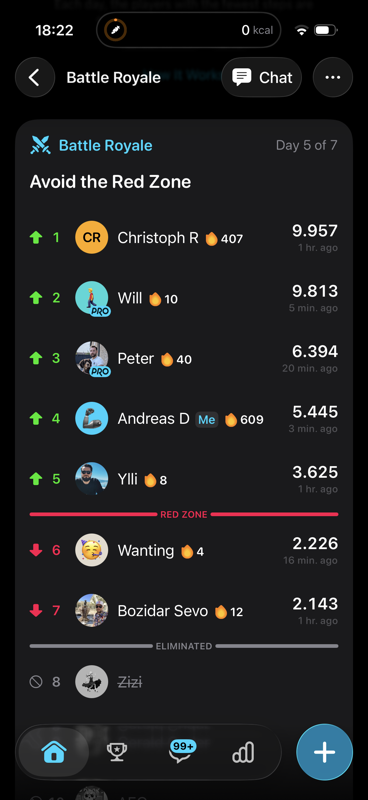
What the Red Zone does psychologically
We spent a lot of time on the visual design of the Red Zone line. It had to communicate real danger without feeling mean.
The line is a clean divider. Above it, you’re safe. Below it, you’re at risk. It’s not personal — it’s mechanical. But it creates this incredible focal point for the whole group.
When I ran the first internal test, I noticed something I didn’t expect: the people just above the line were more anxious than the people in it. They were obsessively checking their step count. They knew they were one slow day away from dropping in.
That near-miss anxiety is a powerful motivator. We leaned into it.
The timestamps on the leaderboard — “5 min. ago”, “1 hr. ago” — amplify this. When you see that someone just updated their count five minutes ago, the competition suddenly feels real and live. Someone is walking right now. The question is whether you are.
See it in action
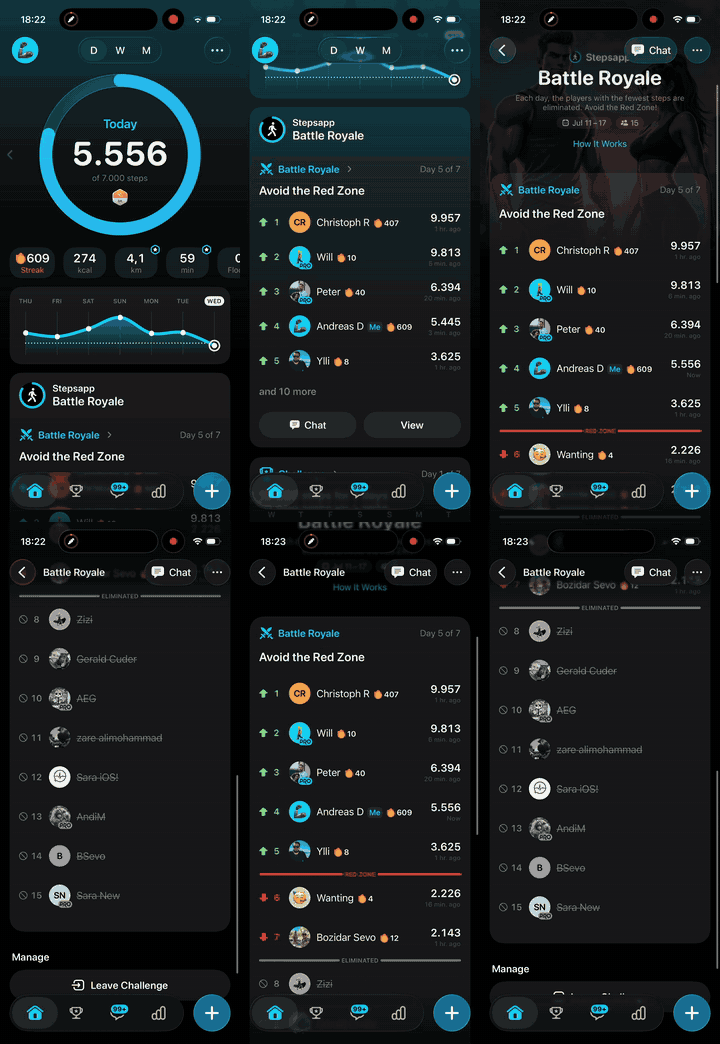
Watch the Red Zone line hold steady while the numbers shift around it. Watch someone creep just above it in the final hours. That’s what engagement looks like — not one big sprint at the end, but continuous daily pressure that keeps everyone moving.
The final days get genuinely intense
A Battle Royale doesn’t have a fixed end date. It runs until one player is left standing — that’s the only finish line. You don’t set a duration. The eliminations decide it. A bigger group might run close to the 7-day maximum; a smaller one can be decided in a few brutal days.
By the time you’re down to the final few survivors, everyone knows each other. The chat has been running for days. Everyone has a story about the day they nearly got knocked out.
The Red Zone requires more steps to escape as the field shrinks — because the weakest players are already gone, and the ones left are serious. The gap between surviving and going home gets tighter every day.
I’ve seen people set their alarm earlier in the final stretch. Not because they planned to. Because they couldn’t stand the idea of losing after surviving this long.
That’s the thing normal challenges almost never produce: genuine stakes right up to the very last person standing.
What I’m still figuring out
I won’t pretend it’s perfect yet. We’re still refining when eliminations happen — local midnight versus a global cutoff creates different dynamics. We’re working on how to handle ties at the Red Zone line fairly. And I want to find a way to celebrate the near-misses — the player who survived by 112 steps should get a moment too.
But the core idea works. Daily elimination keeps people honest. The Red Zone keeps people moving. And the fact that you can’t hide in the middle of the leaderboard is exactly the point.
Try it
Start a Battle Royale in StepsApp →
You need at least 5 players to start — so go and invite a few friends to test it out. 😉
Then watch what happens when the first Red Zone appears and nobody wants to be the first one eliminated.
You’re welcome.
— Ylli